
Broken Car Key Extraction in Manchester, NH
Your Key Just Broke Off - Here's What to Do Next
Standing in a parking lot in Manchester with half a key in your hand and half a key stuck in your ignition is one of the more frustrating ways a day can go sideways. It usually happens without warning — a little more force than usual to turn the ignition, a slight twist in the wrong direction at the door lock, and suddenly you’re holding a broken key head with nothing attached to it.
If you’re dealing with broken car key extraction in Manchester, NH right now, take a breath. This is one of the most common calls we get, and in most cases it’s a fix that takes far less time than people expect — often without needing to replace your entire lock or ignition cylinder.
This page walks through why keys break, what to do (and what not to do) when it happens, and how our mobile service handles broken key extraction on-site,wherever you are in the Manchester area.
Common Signs You Need Broken Key Extraction
Not every “broken key” problem looks the same. Here are the situations we run into most often:
- Key stuck in ignition — the key turned but wouldn’t come back out, or it snapped while turning
- Key broke off in ignition — only the top half of the key came out in your hand, the rest is lodged inside
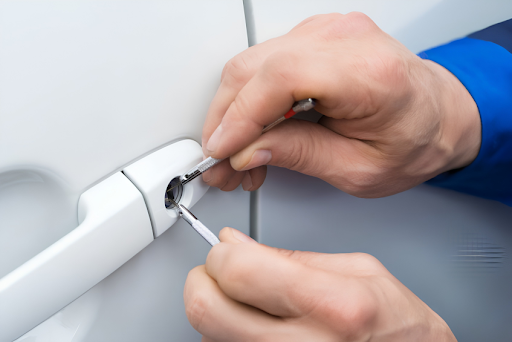
- Broken key stuck in door lock — you tried to unlock the door and the key sheared off partway through the turn
- Car key snapped in half — often from years of wear, a weak point in the metal finally gives out
- Key won’t turn at all, then breaks — a worn ignition cylinder puts extra strain on the key until it fails
If any of these sound familiar, you’re not dealing with a rare or unusual problem. Car keys are metal, and metal fatigues over time — especially keys that get used dozens of times a day, tossed in bags, or exposed to temperature swings the way New Hampshire winters and summers both deliver.
Why Car Keys Break in the First Place
1. Metal fatigue from age and repeated use
2. A worn or dirty lock cylinder
3. Aftermarket or poorly cut keys.
4. Cold weather
5. Turning the key at the wrong angle
What NOT to Do When Your Key Breaks
Before you try to fix this yourself, here are a few things worth avoiding:
- Don’t use pliers or tweezers to yank on the broken piece. This often pushes the fragment deeper or damages the internal pins of the lock.
- Don’t spray in oil, WD-40, or lubricant before extraction. It can make the metal fragment slippery and harder to grip, and it can gum up the internal mechanism.
- Don’t try to superglue the two halves back together and force it out. This almost never works and can leave glue residue inside the lock.
- Don’t keep turning the ignition repeatedly if the key is jammed. This can shift the broken piece further in or damage the tumbler pins.
The safest move is to stop touching it and call a locksmith who has the right tools for the job — this is exactly the kind of situation broken key extraction tools were designed for.
How Our Broken Key Extraction Process Works
We built our process around one goal: get the broken piece out cleanly, without damaging your ignition cylinder or door lock, so you’re not paying for a full lock replacement when a simple extraction will do.
Step 1 — On-site diagnosis. We come to your location in Manchester or the surrounding area and take a look at exactly where the break happened and how much of the key is exposed.
Step 2 — Careful extraction. Using specialized key extractor tools — thin, hooked, or barbed picks designed specifically for this job — we remove the broken fragment without forcing or damaging the lock mechanism.
Step 3 — Lock inspection. Once the fragment is out, we check the condition of the ignition or door lock to rule out the underlying cause (wear, debris, misalignment) that led to the break in the first place.
Step 4 — New key cut or programmed. If you need a replacement key on the spot, we can cut a new mechanical key or program a new transponder key, depending on your vehicle. If you have a spare, we may be able to duplicate it right there.
Most extractions are completed on location without needing to tow your vehicle anywhere — that’s the whole point of a mobile service.
What Our Customers Say
Posted on GoogleTrustindex verifies that the original source of the review is Google. Very helpful, came straight out the same day and had the issue solved with no complications for a great pricePosted on GoogleTrustindex verifies that the original source of the review is Google. Thank you for the amazing service. You went above and beyond to help me in my situation. I would recommend this locksmith over anyone else!Posted on GoogleTrustindex verifies that the original source of the review is Google. I called three different locksmiths before I called him, no one would give me an honest answer or a quote for the job. He immediately gave me one and got out to my truck in 15 minutes. He did amazing work and I would absolutely go to him for now on.Posted on GoogleTrustindex verifies that the original source of the review is Google. I called Jimmy this afternoon when locked out of my vehicle. Very prompt showed up within 10 mins and had it unlocked. Would 10/10 recommend and will call him again!!!Posted on GoogleTrustindex verifies that the original source of the review is Google. Great work, Fast, good communication! He was able to make and program a new key for me in just 20min!Posted on GoogleTrustindex verifies that the original source of the review is Google. I am so grateful for Jimmy! I locked myself out of my car and he helped me get back in, in no time! He ended up generating a second key for me which I definitely needed. He was very professional and kind, highly recommend. Thank you!Posted on GoogleTrustindex verifies that the original source of the review is Google. lost my key and called was here in an hour and had one ready for me in no time 10/10 and would highly recommend !Posted on GoogleTrustindex verifies that the original source of the review is Google. Jimmy was so prompt and professional. I called him short notice on a Sunday holiday weekend and he got out to me within 10 minutes at a great price. Thanks Jimmy!Posted on GoogleTrustindex verifies that the original source of the review is Google. Great and fast service. Worked with to get a new key and key fob for my truck. Also helped me unlock my truck after my keys were locked in. Greatly appreciatedPosted on GoogleTrustindex verifies that the original source of the review is Google. Jimmy came out and generated a new key fob for my vehicle. Super fast and great to work with. I highly recommend.
Why Choose a Mobile Locksmith Over a Dealership
A dealership can help with broken key extraction, but there are a few practical differences worth knowing:
- We come to you. Whether you’re stuck in a driveway, a parking lot, or on the side of the road in Manchester, we bring the tools to your location instead of requiring a tow.
- Faster turnaround. Dealerships often need to schedule appointment days out. A mobile locksmith can typically respond the same day.
- Broken key extraction is a specialty, not a side task. Automotive locksmiths handle this specific situation constantly, with tools built for exactly this job.
- No unnecessary lock replacements. Extraction, when done carefully, often saves the lock — meaning a lower repair cost than a full ignition or lock replacement.
We’re licensed and insured, and we’ve handled broken key extractions across a wide range of makes and models — from older mechanical keys to modern transponder and smart keys.
Areas We Serve Near Manchester, NH
Broken key extraction service is available throughout Manchester and the surrounding communities, including Bedford, Londonderry, Derry, Nashua, Hooksett, Merrimack, Goffstown, and Concord. If your key breaks anywhere in the greater Manchester area, we can typically reach you the same day.
FAQs
What should I do if my car key breaks off in the ignition?
Stop trying to turn or remove the broken piece yourself and avoid pushing it deeper into the ignition. A professional automotive locksmith can use specialized extraction tools to remove the fragment safely.
- Can a broken key be removed without replacing the ignition?
Yes. In many cases, the broken fragment can be extracted while leaving the existing ignition cylinder intact.- What happens after the broken key is removed?
The locksmith can inspect the ignition for damage and, if needed, cut or program a replacement key.
- What happens after the broken key is removed?
- Should I try to pull the broken key out myself?
It is generally better to avoid pliers, tweezers, or other improvised tools because they can push the fragment deeper or damage the lock.
Can a locksmith extract a broken car key from the ignition in Manchester, NH?
Yes. A mobile automotive locksmith can travel to your location and use specialized extraction tools to remove a broken key from an ignition.
- Can broken key extraction be done without towing the car?
In most cases, yes. The extraction can be performed on-site at a driveway, parking lot, or roadside location.- Can the locksmith make a replacement key after extraction?
Yes. Depending on the vehicle, a replacement mechanical, transponder, or other compatible key may be cut or programmed on-site.
- Can the locksmith make a replacement key after extraction?
- Can a locksmith extract a key that is stuck deep inside the ignition?
Yes. Specialized extraction tools can be used for fragments that are partially or deeply lodged inside the cylinder.
Why did my car key snap in half?
Car keys can break because of metal fatigue, repeated use, a worn lock cylinder, improperly cut keys, cold weather, or excessive force.
- Can a worn ignition cause a car key to break?
Yes. A worn or damaged ignition can create additional resistance, requiring more force and putting extra stress on the key.- Does cold weather make car keys more likely to break?
Cold temperatures can make materials more brittle, while frozen or stiff locks can increase resistance when turning the key.
- Does cold weather make car keys more likely to break?
- Can an incorrectly cut key cause breakage?
Yes. A poorly cut or off-spec key can place uneven pressure on the lock and increase wear.
Can a locksmith remove a broken key from a car door lock?
Yes. A broken key stuck in a car door lock can often be extracted using specialized tools designed to remove the fragment without unnecessarily damaging the lock.
- Can the door lock still work after the broken key is removed?
Often, yes. The locksmith can inspect and test the lock after extraction.- Can you make a new key after removing the broken piece?
Yes. A replacement key can often be cut based on the vehicle and available key information.
- Can you make a new key after removing the broken piece?
- What if the broken key is completely inside the door lock?
The locksmith can assess how deeply the fragment is lodged and select an appropriate extraction method.
How much does broken car key extraction cost in Manchester, NH?
The cost depends on factors such as the vehicle, location of the broken fragment, lock condition, and whether a replacement key is also required.
- Is broken key extraction cheaper than replacing an ignition?
Usually, extraction is less expensive when the ignition or door lock remains functional and does not need replacement.- Does making a replacement key add to the cost?
Yes. Key cutting and electronic programming, when required, are separate factors that can affect the total price.
- Does making a replacement key add to the cost?
- Can I get a price before the locksmith starts?
You can provide your vehicle details and describe the problem when calling so the locksmith can give you an estimate before beginning the work.
How long does broken car key extraction take?
Many broken key extractions can be completed during a short on-site service visit, but the exact time depends on how deeply the fragment is lodged and the condition of the lock.
- Can the extraction be completed on-site?
Yes. Mobile locksmiths bring specialized extraction equipment directly to the vehicle.- Will I need to tow my car after a broken key extraction?
Usually not if the ignition and vehicle systems are otherwise functioning normally.
- Will I need to tow my car after a broken key extraction?
- Can a replacement key be made during the same visit?
In many cases, yes, depending on the vehicle and the type of replacement key required.
What should I avoid doing when a car key breaks?
Avoid forcing the broken fragment, repeatedly turning the ignition, or using improvised tools that could push the key deeper or damage the lock.
- Can I use pliers to remove a broken car key?
If the fragment is not easily accessible, pliers can push it farther inside or damage the lock, so professional extraction is generally safer.- Should I use WD-40 or oil before removing the broken key?
The page recommends avoiding lubricants before extraction because they can make the fragment harder to grip and may affect the lock mechanism.
- Should I use WD-40 or oil before removing the broken key?
- Should I glue the broken key back together?
No. Glue can leave residue inside the lock and potentially make extraction more difficult.
Can a locksmith make a new car key after broken key extraction?
Yes. After removing the broken fragment, a locksmith may be able to cut a replacement mechanical key or program a transponder or smart key, depending on the vehicle.
- Can a locksmith program a transponder key on-site?
For compatible vehicles, yes. Mobile locksmiths may have the equipment needed to program replacement transponder keys at the vehicle.- Can a new key be made if the original key is completely broken?
Yes. The broken key does not necessarily need to be intact for a replacement to be produced.
- Can a new key be made if the original key is completely broken?
- Can you duplicate a spare key after extraction?
If you have a functioning spare, the locksmith may be able to duplicate it depending on the vehicle and key type.
Is broken car key extraction available near Manchester, NH?
Yes. The landing page states that mobile broken key extraction service is available throughout Manchester and surrounding communities.
- What areas near Manchester does the locksmith serve?
Listed communities include Bedford, Londonderry, Derry, Nashua, Hooksett, Merrimack, Goffstown, and Concord.- Can a mobile locksmith come to my location?
Yes. The mobile service is designed to bring the extraction equipment directly to the vehicle.
- Can a mobile locksmith come to my location?
- Can roadside broken key extraction be performed?
Yes. The service can assist with broken keys when a vehicle is stranded at an accessible roadside location.
Is it better to call a locksmith or a dealership for a broken car key?
For a broken key that needs immediate extraction, a mobile automotive locksmith can be more convenient because the technician comes directly to the vehicle.
- Why choose a mobile locksmith for broken key extraction?
You can potentially avoid towing the vehicle and waiting for a dealership appointment.- Can a locksmith handle broken keys for modern vehicles?
Many automotive locksmiths work with vehicles using traditional keys, transponder keys, and modern electronic key systems.
- Can a locksmith handle broken keys for modern vehicles?
- When might a dealership be necessary?
Certain specialized vehicles or manufacturer-specific security systems may require dealership equipment or procedures.
What causes a key to get stuck in the ignition before it breaks?
A key may become difficult to turn or remove because of a worn ignition cylinder, debris, mechanical problems, steering-wheel tension, or a damaged key.
- Should I keep forcing a key that will not turn?
No. Excessive force can increase the chance of snapping the key inside the ignition.- Can a locksmith check the ignition after extracting the key?
Yes. Inspecting the ignition can help identify whether wear or another mechanical issue contributed to the key breaking.
- Can a locksmith check the ignition after extracting the key?
- Can replacing only the key solve the problem?
Not always. If the ignition cylinder is worn or damaged, replacing the key alone may allow the same problem to happen again.